Dental crown

THE Crown

Prosthetic crowns can be used to reconstruct very dilapidated teeth, whether they are devitalized or not.

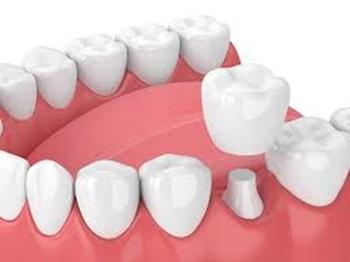
These are caps that crimp the remaining tooth stump to consolidate it and restore the shape and functions of the teeth.

For devitalized teeth, the crown must be anchored in the root by a tenon (or pivot or inlay-core). This tenon can sometimes be integral with the prosthetic crown, but it is most often independent.

Main steps in making a prosthetic crown:

  • The tooth is prepared and a temporary resin crown is placed.
  • If the tooth is devitalized, a tenon is placed in the tooth, either directly or by passing through an impression of the inside of the root.
  • An impression is taken and sent to the prosthetist so that he can make the crown.
  • The crown is placed after a fitting.


Couronnes 1

Crowns consolidate and restore the shape of teeth

The choice of crown meets qualitative, financial and aesthetic criteria

The resin crown or temporary crown protects the tooth during the design stages of the definitive crown. However, over time, the resin becomes porous and microbes pass through; it is therefore necessary to avoid keeping it for too long.

The metal-ceramic crown consists of a metal shell covered with a ceramic that has the same color as the teeth. The presence of metal under the ceramic does not allow the same degree of translucency as natural teeth, which can give an opaque appearance to the crown.

The all-ceramic crown uses highly advanced design processes. It consists of an extremely resistant ceramic framework, covered with a cosmetic ceramic that is the same color as the teeth. These metal-free crowns have an excellent aesthetic appearance and superior biocompatibility to metal-ceramic crowns.


Our advice:

A crowned tooth must be checked very regularly in order to intercept any possible start of decay at the joint
THE CERAMIC DENTAL CROWN

This all-ceramic crown can be made of zirconia, lithium disilicate, monolithic or laminated.

The choice of technique will depend on the resistance and the desired degree of aesthetics.

Specificities:

  • Very high biocompatibility: no allergy linked to metal, no interaction with other restoration materials.
  • Long-term resistance and stability.
  • Significant mechanical qualities allowing the production of single crowns but also small bridges.
  • No visible transition at the edge of the gum (no grayish border appearing at its base).

Design & manufacturing:

  • Advanced processes using CAD/CAM (Computer Aided Design and Manufacturing) are used.
  • The molding of your impressions is scanned to be transformed into digital data. This data is then sent to CAD software to visualize your impressions in 3D and design the core of the future crown.
  • These elements are then processed by a machine tool that mills a block of ceramic to make the crown cap.
  • Finally, the dental technician covers this base with a cosmetic ceramic to make a tooth with the shape and color of your natural teeth.